
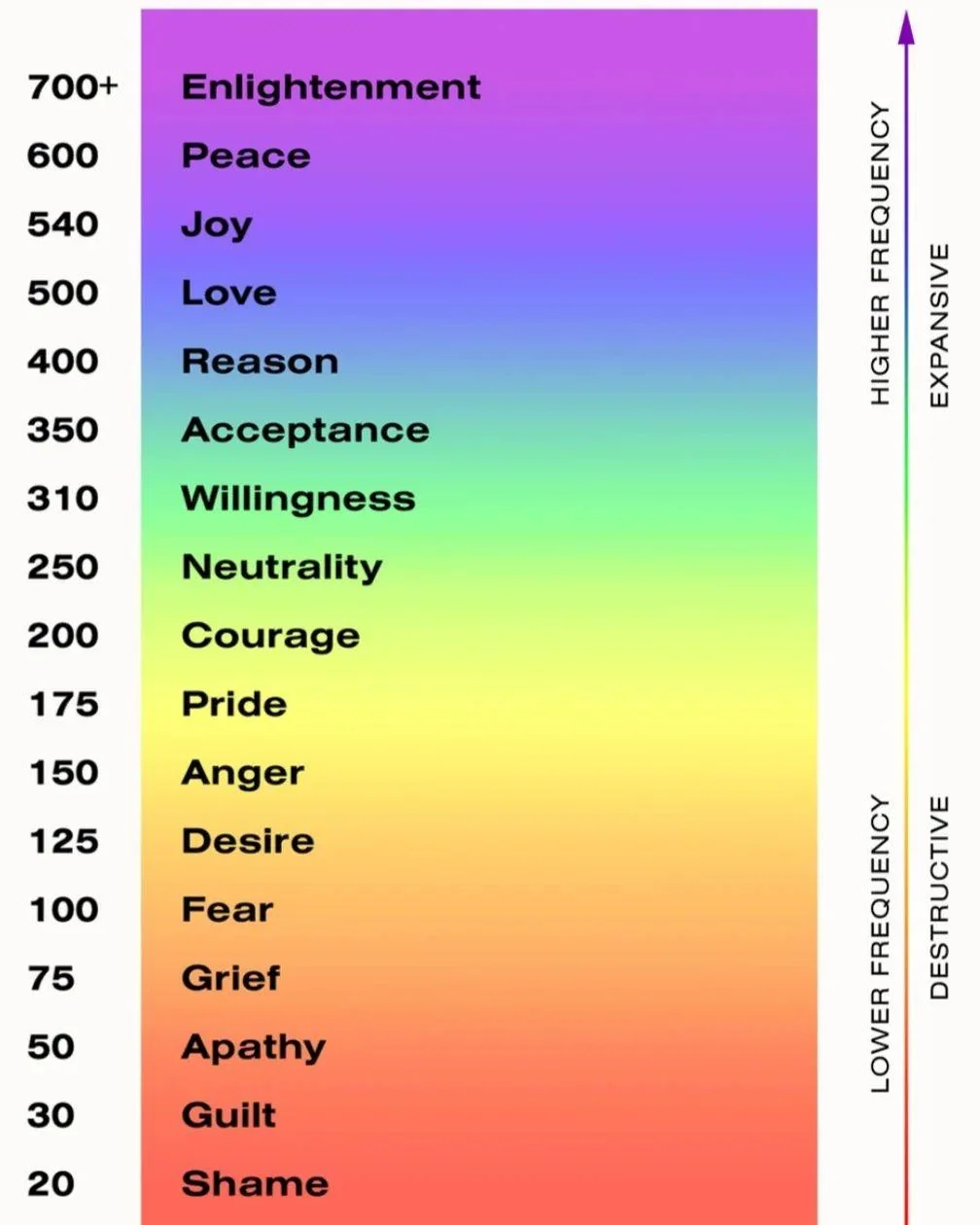
Enlightenment is the highest achievable state on Hawkins’ Emotional Frequency Scale. It is the ultimate emotional state that a human being can reach.
Buddhists know enlightenment as nirvana, a transcendental state in which there is no suffering or desire.
Another perhaps more practical and philosophical definition of enlightenment is ‘man’s emergence from his self-imposed immaturity’ (Kant, 1784)1.
In either case, enlightenment is defined in contrast to what it is not (rather, what it is no longer).2 Putting the definitions together, we could say that enlightenment is a state of going beyond one’s own immaturity, which is rife with suffering and desire.
What Enlightenment Is Not
What, then, is this state of immaturity filled with suffering and desire?
It is the state most commonly known to man as the ego.
The ego is the part of every human being that is self-serving and self-protecting. Its main job is to keep us alive. It is the part of us that forms self-identity and then works to preserve that identity amidst the many threats presented by the world.
The ego loves to be right. It loves to achieve and receive external validation.
It loves to create drama.
It creates narratives about the self and about others and likes to compete.
It will even belittle its own self. It will doubt itself. It will talk itself into circles.
The ego is tricky and complex. It can get messy.
If you ask any Arahant (a Buddhist practitioner who has attained complete Enlightenment), he won’t tell you that he attained enlightenment by way of reasoning through his mind.
One of the fundamental teachings of Buddhism with regard to Enlightenment, is that enlightenment is not found through the mind, but beyond it.
This is because the mind is where the ego primarily operates. It reasons, it calculates, it plans. The transcendental, enlightened state, however, is beyond all of this. It is the limitless state, in fact, that exists beyond linear time.
This is the most beautiful, humbling part of it all – enlightenment is not a destination. It is available now. Right now.
Our minds which operate by linear time would have us believe that we have to work toward enlightenment, that we need a timeline and a set date by when we will reach this state. Before we realize it, we are rationalizing and planning for a state that exists beyond those very mental faculties.
Hence, our ego has unintentionally tricked us again into cyclical thinking. We end up striving for something that cannot be strived for.
It is a catch-22.
What Enlightenment Is
Enlightenment is a state of being completely, nonjudgmentally aware of all the tricks and patterns of the mind. It is a state of pure observation. Blissful and skillful acceptance.
This may sound contradictory, but it will all make sense in the end: Enlightenment cannot be achieved without the mind. That would mean negating an inherent part of ourselves. That would be a falsity, an illusion, a trick of the mind in itself.
This, enlightenment can only be achieved with the mind. Through careful observation, understanding, and acceptance of its antics.
Enlightenment in and of itself is not a serious undertaking. By observing how insane and contradictory the mind can be, one learns to laugh and not take oneself and life so seriously anymore.
Enlightenment is about being present with the insane mind and existing beyond it. Not interacting with it or going into its endless long-haul narratives about who did you wrong, or why you are justified in your anger, or the paranoia of threats circling you.
It is about observing the narratives the mind creates in an attempt to keep you safe.
Thanking the mind for working so hard and reassuring it, that all is fine.
One cannot escape the mind. Thus, enlightenment is learning to befriend the mind.
In some spiritual communities, there can be a bashing of the ego that happens, whereby people develop this idea that the ego is ‘bad’ and must be overcome. This is a partial truth in the sense that yes, an unchecked ego can cause extreme violence and damage, but the ego by itself is not good nor bad, rather it simply exists to protect our survival.
In this, we can learn to thank the ego and work with it, rather than against it. The latter will always keep us stuck within another mind trick, preventing us from experiencing actual enlightenment, whilst projecting the illusion that we are ‘working’ toward ‘reaching’ enlightenment. Notice the words in quotes are always a trick of the mind. True enlightenment is not something that is worked toward or reached, it is a state that naturally happens. It just is.
It is available at any time, including now.
Footnotes
- Kant, I. (1784). An Answer to the Question: What is Enlightenment?[ [Review of An Answer to the Question: What is Enlightenment?[]. https://www.nypl.org/sites/default/files/kant_whatisenlightenment.pdf
↩︎ - The ego would like to make us think that enlightenment is the opposite of the ego, but that is the trick. It is not the opposite, but the going beyond the ego which involves befriending the ego. ↩︎

Response
I love the way you defined enlightment! something that’s not easy to grasp.